
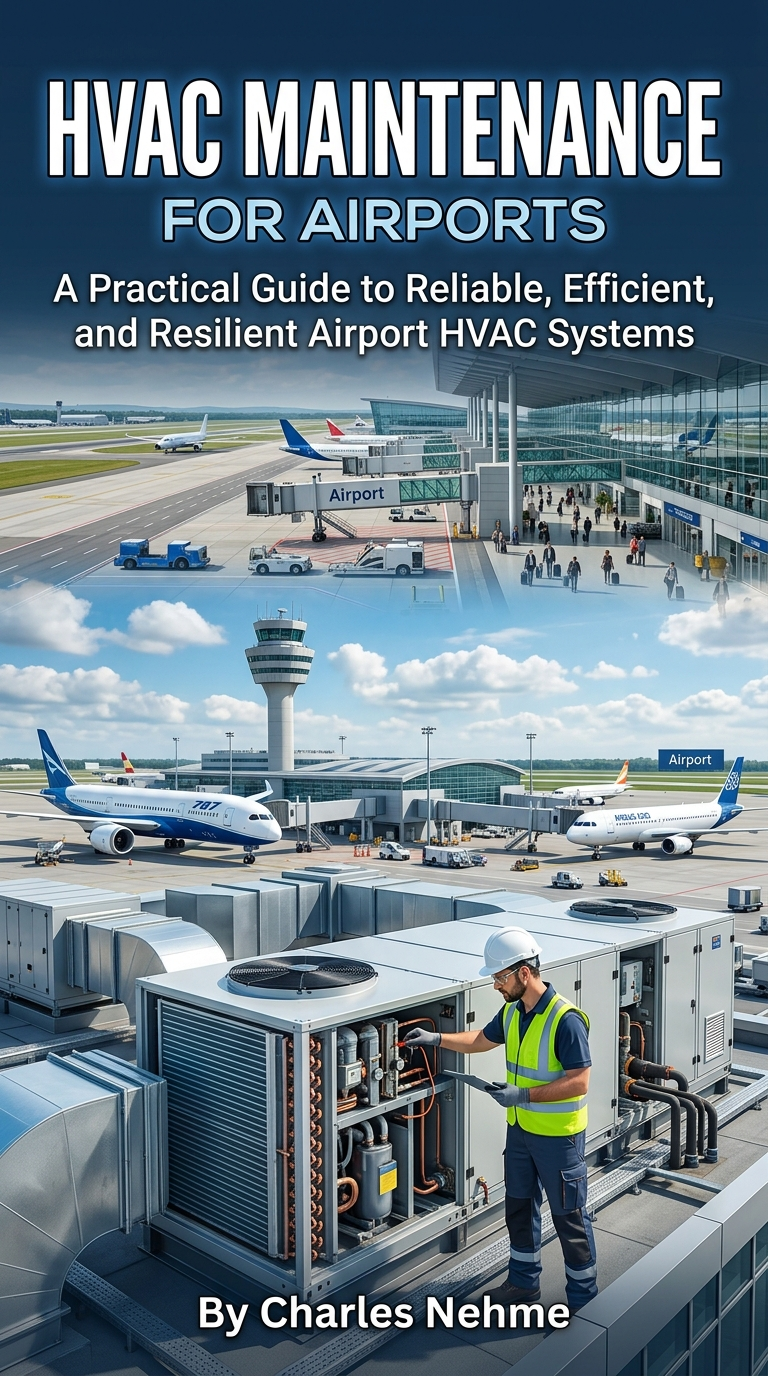
HVAC Maintenance for Airports, A Practical Guide to Reliable, Efficient, and Resilient Airport HVAC Systems
Airports are among the most demanding environments in which HVAC systems must operate.
Unlike conventional commercial buildings, airports function as highly complex, continuously operating facilities where thousands of passengers, employees, aircraft, security systems, baggage operations, retail areas, restaurants, offices, and technical systems coexist. The HVAC infrastructure supporting these activities must deliver comfort, ventilation, temperature and humidity control, air quality, pressurization, and reliability—often around the clock.
A failure that might be a minor inconvenience in an office building can become a significant operational problem in an airport.
A failed air-handling unit can affect an entire terminal zone. A malfunctioning chilled-water plant can compromise thousands of square meters of occupied space. Poor ventilation can create passenger discomfort and indoor-air-quality concerns. A control-system failure can cause simultaneous problems across multiple terminal areas. In critical spaces such as control rooms, IT rooms, electrical rooms, security areas, and operational facilities, HVAC failure can have consequences far beyond passenger comfort.
This makes airport HVAC maintenance a specialized engineering discipline.
The objective of this book is to provide a practical framework for maintaining airport HVAC systems with a focus on reliability, availability, performance, energy efficiency, and lifecycle management.
The book moves beyond simple equipment servicing. Effective maintenance is not merely changing filters, lubricating bearings, cleaning coils, or repairing failed components. It requires understanding how individual pieces of equipment interact as part of a larger system.
A chiller cannot be evaluated independently from its pumps and cooling towers. An AHU cannot be evaluated simply by checking whether its fan operates. Its airflow, filters, coils, dampers, controls, sensors, pressure relationships, and associated terminal systems must also be considered.
Likewise, an airport HVAC maintenance program cannot be separated from airport operations.
Maintenance activities must be coordinated with flight schedules, passenger flows, security requirements, restricted-access areas, tenant operations, seasonal conditions, and emergency procedures. Planned maintenance must therefore minimize operational disruption while ensuring that critical systems remain available.
This book presents a structured approach to achieving that objective.
It covers central cooling and heating plants, air-handling systems, ventilation, hydronic systems, controls, building automation, indoor air quality, specialized airport spaces, energy optimization, emergency response, reliability engineering, and maintenance management.
Particular attention is given to the transition from reactive maintenance to proactive maintenance.
The question should no longer be:
"What equipment has failed?"
but rather:
"What equipment is showing signs that it may fail, and what can we do before it affects airport operations?"
That change in thinking is at the heart of modern HVAC maintenance.
Condition monitoring, trend analysis, equipment criticality assessments, predictive maintenance, automated fault detection, energy monitoring, and computerized maintenance management systems can all contribute to a more reliable airport HVAC infrastructure.
The ultimate goal is not simply to keep HVAC equipment running.
It is to create an HVAC infrastructure that airport operators can trust.
Check out https://bit.ly/m/HVAC for much more