
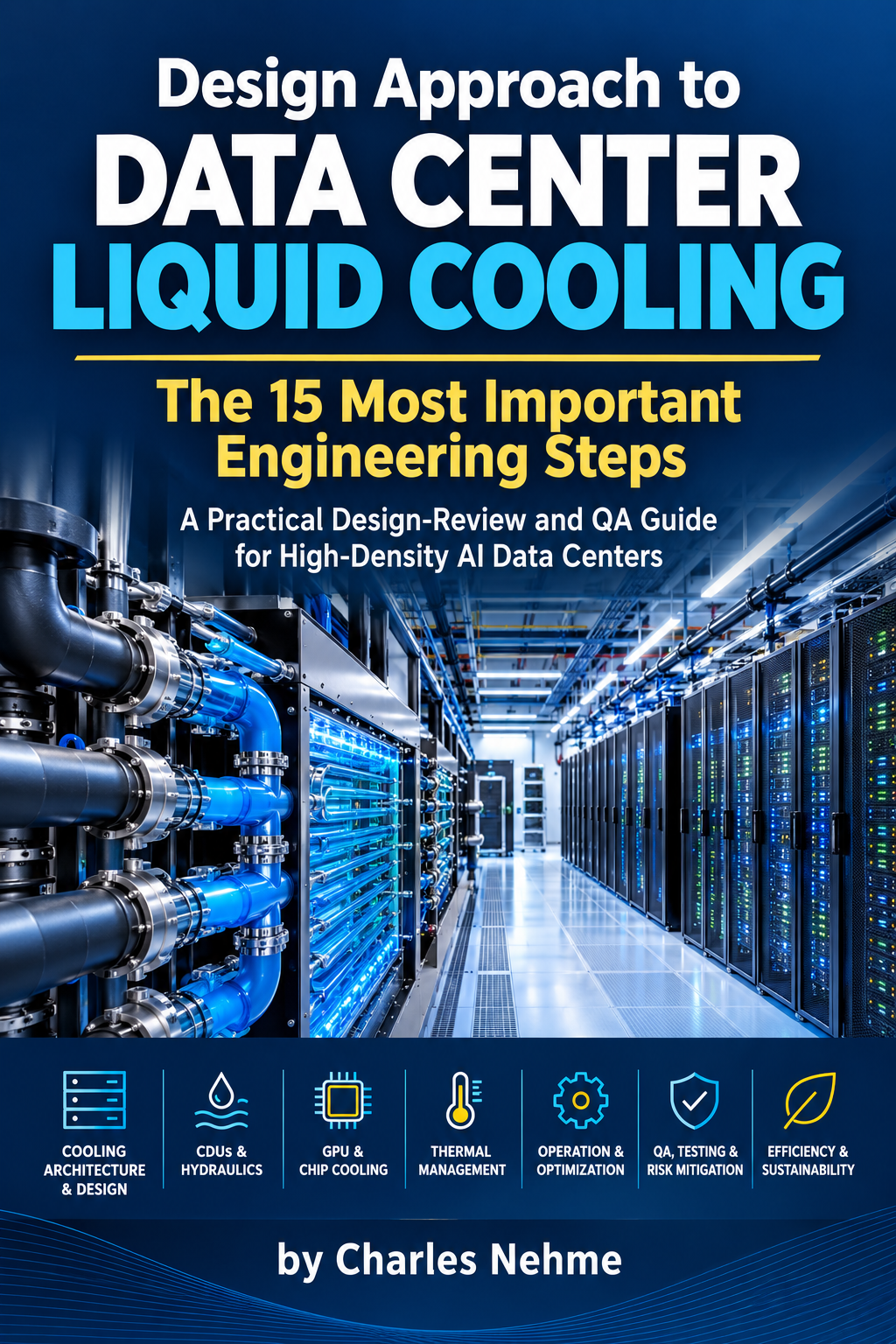
Design Approach to Data Center Liquid Cooling, The 15 Most Important Engineering Steps.
For two decades, data center cooling design followed a familiar pattern: estimate the IT load in kilowatts, choose a rack density, and then size air handlers, chillers, and containment around that number. The cooling system was largely a facility problem. The IT equipment simply asked for cold air and the mechanical engineer delivered it.
High-density AI infrastructure breaks that pattern. Accelerator-based servers concentrate hundreds of watts of heat into a package the size of a hand, and racks built around them can reach densities that air cannot practically remove. Liquid has far greater volumetric heat capacity than air, so moving heat with a coolant loop becomes the only workable option once densities climb beyond what containment and fans can handle. But the move to liquid does not merely replace one heat-transfer medium with another. It changes who owns the design, what the critical interfaces are, and how failure looks.