
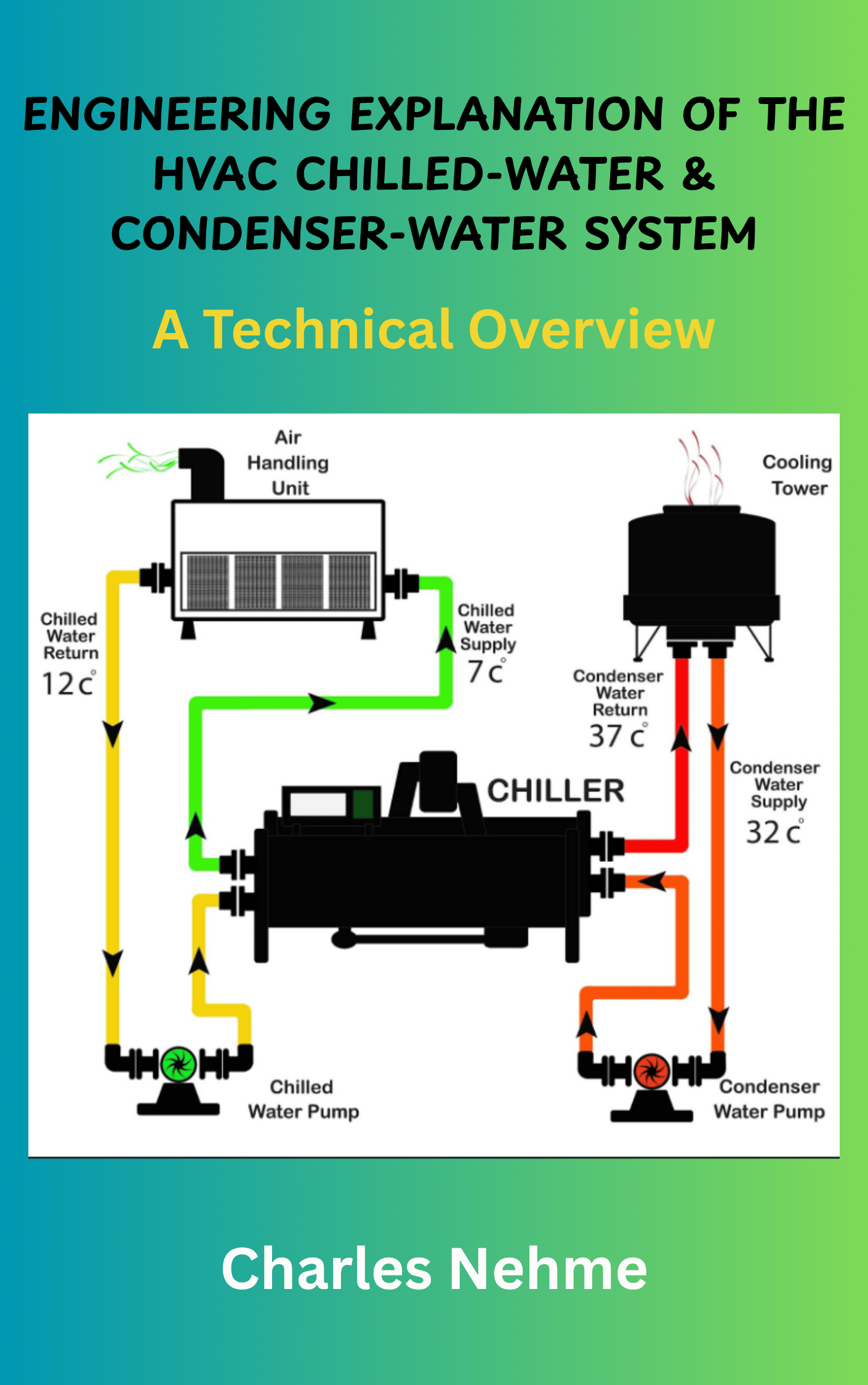
ENGINEERING EXPLANATION OF THE HVAC CHILLED-WATER & CONDENSER-WATER SYSTEM
HVAC systems have evolved into some of the most critical components in today’s built environment. Whether in commercial towers, residential complexes, industrial plants, or high-precision facilities such as datacenters and laboratories, the demand for stable, efficient, and intelligent environmental control has never been higher. Modern projects increasingly require engineers to integrate mechanical systems with digital monitoring platforms, energy-saving strategies, psychrometric analysis, and advanced troubleshooting frameworks. As HVAC grows more interdisciplinary, engineers must possess not only theoretical knowledge but also a practical understanding of how real-world systems operate, fail, and perform under dynamic conditions.
This book was written to provide a clear, structured, and detailed explanation of an HVAC schematic and its engineering components. Each section breaks down the logic behind the system—airflow, duct routing, cooling and heating strategies, pressure relationships, filtration, control sequences, and safety considerations. Rather than presenting isolated concepts, the book explains how each component interacts with the system as a whole. The goal is to transform a seemingly complex schematic into a fully understood and logically connected design.
Throughout the chapters, readers will find engineering-level descriptions supported by energy-efficiency considerations, best practices in design and commissioning, and industry standards derived from decades of field experience. This approach ensures that both beginners and experienced professionals can extract value—whether as a study reference, design guide, or troubleshooting aid.
Ultimately, the purpose of this book is simple: to demystify HVAC schematics and empower engineers, technicians, and building operators with deep system comprehension. When HVAC systems are well-designed and properly understood, buildings operate more efficiently, comfort is enhanced, and long-term operational costs are significantly reduced. It is my hope that this book contributes to that mission and supports professionals worldwide in building smarter, cleaner, and more sustainable environments.
Author:
Charles Nehme is an HVAC and MEP engineering specialist with over 30 years of global experience across industrial, commercial, and high-tech projects. His expertise spans datacenters, cleanrooms, pharmaceuticals, semiconductors, hospitals, laboratories, hospitality, and large-scale mixed-use developments. Having worked on multiple continents and in diverse regulatory environments, he brings a uniquely international perspective to HVAC design, troubleshooting, and optimization.
Charles is also the founder of CFN-HVAC, a technical consulting and knowledge services firm that provides remote HVAC engineering support, design review, energy analysis, training, and promotional technical writing for companies worldwide. His work includes hundreds of technical articles, guides, and books covering HVAC systems, energy efficiency, sustainability, MEP engineering, and emerging technologies such as IoT, AI-driven controls, and BIM workflows.
He is known for his ability to simplify complex engineering topics without compromising technical accuracy. Through books, courses, and consulting, he has helped thousands of engineers, technicians, and building professionals strengthen their understanding of real-world HVAC systems.
Beyond engineering, Charles collaborates with manufacturers and engineering firms to create promotional technical books that help companies communicate their products and innovations more effectively to clients.
His mission is to make HVAC knowledge accessible, practical, and actionable—whether for seasoned engineers or newcomers in the field.