
Liquid Immersion Cooling Transitions for High-Density GPU Server Deployments
Artificial intelligence, high-performance computing, and accelerated computing are transforming the data center industry. GPU servers are becoming more powerful, rack densities are increasing, and the amount of heat generated within a relatively small physical space is reaching levels that conventional air-cooling systems were never designed to manage efficiently.
For many years, the basic strategy was straightforward: deliver more cold air, increase airflow, improve containment, and install additional cooling capacity. However, as rack power densities continue to rise, this approach faces physical and economic limitations. Higher airflow requires more fan energy, larger air-handling systems, greater pressure differentials, and increasingly complex containment strategies. Eventually, simply moving more air is no longer the most practical solution.
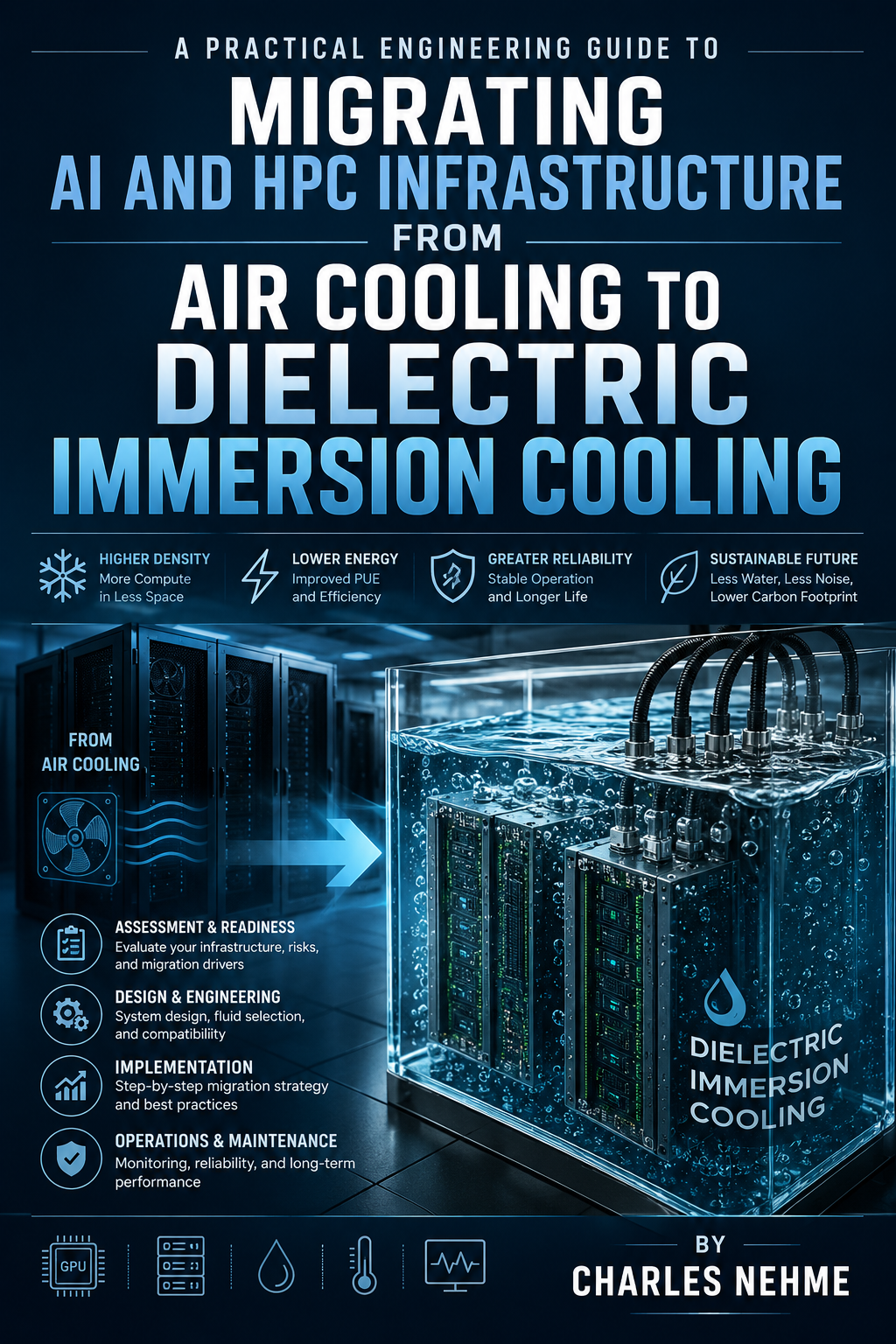
Liquid immersion cooling represents a significant shift in how engineers approach the thermal management of high-density computing infrastructure. Instead of relying primarily on air as the heat-transfer medium, servers and electronic components are placed directly in carefully engineered dielectric fluids capable of absorbing and transporting large amounts of heat.
However, moving to immersion cooling is not simply a matter of replacing a server rack with an immersion tank.
A successful transition requires engineers and operators to understand the complete thermal chain: from the semiconductor surface to the dielectric fluid, from the fluid to the heat exchanger, through the secondary cooling loop, and ultimately to the facility's heat-rejection system. Fluid viscosity, thermal conductivity, specific heat, flow characteristics, heat-transfer coefficients, pumping energy, heat exchanger approach temperatures, water temperatures, redundancy, maintainability, and hardware compatibility all become part of an integrated engineering problem.
This book was written to provide a practical framework for understanding that transition.
Rather than treating immersion cooling as an isolated technology, Liquid Immersion Cooling Transitions for High-Density GPU Server Deployments examines the entire infrastructure system. It explores why air cooling eventually becomes a thermal bottleneck, how dielectric fluids influence heat transfer, how immersion tanks connect to secondary cooling loops, and how existing data centers can transition toward higher-density computing environments.
Special attention is given to the engineering decisions that determine whether an immersion cooling deployment will deliver its expected benefits. A system may provide excellent heat removal at the tank level while creating unnecessary pumping energy, poor heat exchanger performance, operational complexity, or reliability concerns elsewhere in the facility. True optimization requires looking beyond individual components and evaluating the complete system.
The objective of this book is therefore not simply to explain immersion cooling technology. It is to help engineers, consultants, designers, and operators make better decisions when evaluating, designing, retrofitting, commissioning, and operating immersion-cooled infrastructure.
As AI workloads continue to grow, thermal management will increasingly influence the design of electrical systems, mechanical plants, building structures, controls, water infrastructure, and the physical arrangement of computing equipment. The boundary between IT infrastructure and facility infrastructure is becoming increasingly interconnected.
The future data center will not be designed around cooling as a secondary utility. Thermal management will become a central part of computing capacity.
This book is intended to help professionals understand and navigate that transition.