
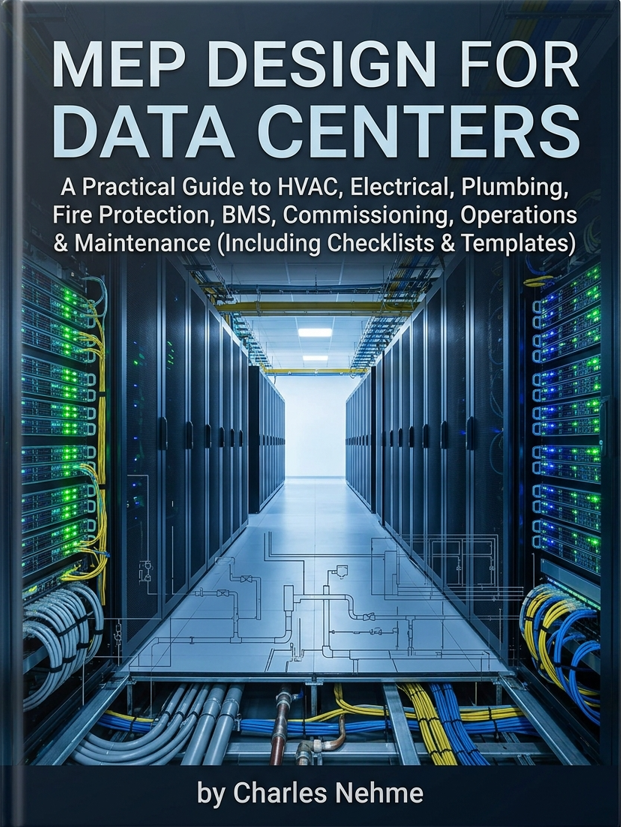
MEP Design for Data Centers A Practical Guide to HVAC, Electrical, Plumbing, Fire Protection, BMS, Commissioning, Operations & Maintenance (Including Checklists & Templates)
Data centers have become the backbone of the modern economy. Every cloud transaction, financial exchange, streaming service, healthcare record, artificial intelligence workload, and industrial control process depends on facilities that must operate continuously, reliably, and efficiently. In this environment, the performance of the Mechanical, Electrical, and Plumbing (MEP) systems is not simply a support function—it is the foundation of uptime.
The purpose of this book is to provide a practical and integrated guide to MEP Design for Data Centers, covering the critical disciplines that determine operational resilience: HVAC, electrical power distribution, fire protection, plumbing, building management systems (BMS), commissioning, maintenance, and facility operations. Rather than treating these systems as isolated engineering packages, this book emphasizes how they interact to support a mission-critical facility.
Throughout my career working on data centers, commercial facilities, industrial plants, and other complex MEP projects, I have observed that many failures occur not because individual components were poorly selected, but because the interfaces between systems were not fully understood. A cooling strategy affects electrical loading; power redundancy influences equipment layout; fire protection requirements impact airflow management; and control systems determine how all these elements respond during normal operation and emergency conditions.
This book has been written for MEP engineers, data center consultants, commissioning professionals, facility managers, owners’ representatives, and technical decision-makers who require a clear, field-oriented reference. The content combines engineering principles with practical design considerations, operational experience, testing methodologies, and maintenance strategies that can be applied to both new and existing facilities.
Inside these chapters, readers will find guidance on:
- Calculating and managing IT thermal loads
- Selecting appropriate cooling architectures
- Designing reliable electrical distribution and backup power systems
- Implementing effective fire detection and suppression strategies
- Managing water systems and leak prevention
- Integrating BMS and monitoring platforms
- Coordinating multidisciplinary MEP designs
- Executing commissioning and integrated systems testing
- Developing maintenance programs that support long-term uptime
- Preparing for emerging technologies such as liquid cooling and AI-driven optimization
The data center industry continues to evolve rapidly, with increasing rack densities, higher power demands, stricter sustainability targets, and greater expectations for reliability. The engineer of today must understand not only how to design systems, but also how those systems will be operated, maintained, tested, and adapted over time.
My objective is that this book serves as both a design reference and an operational handbook—a resource that can be consulted during concept development, detailed engineering, commissioning, troubleshooting, and ongoing facility management.
Ultimately, successful data center design is about more than equipment selection. It is about creating an integrated infrastructure capable of supporting critical digital operations under all conditions, while balancing reliability, efficiency, maintainability, and future expansion.
I hope this book contributes to that goal and provides practical value to professionals responsible for delivering and operating mission-critical facilities around the world.
Charles Nehme
MEP & HVAC Global Consultant
CFN-HVAC
https://bit.ly/m/HVAC