
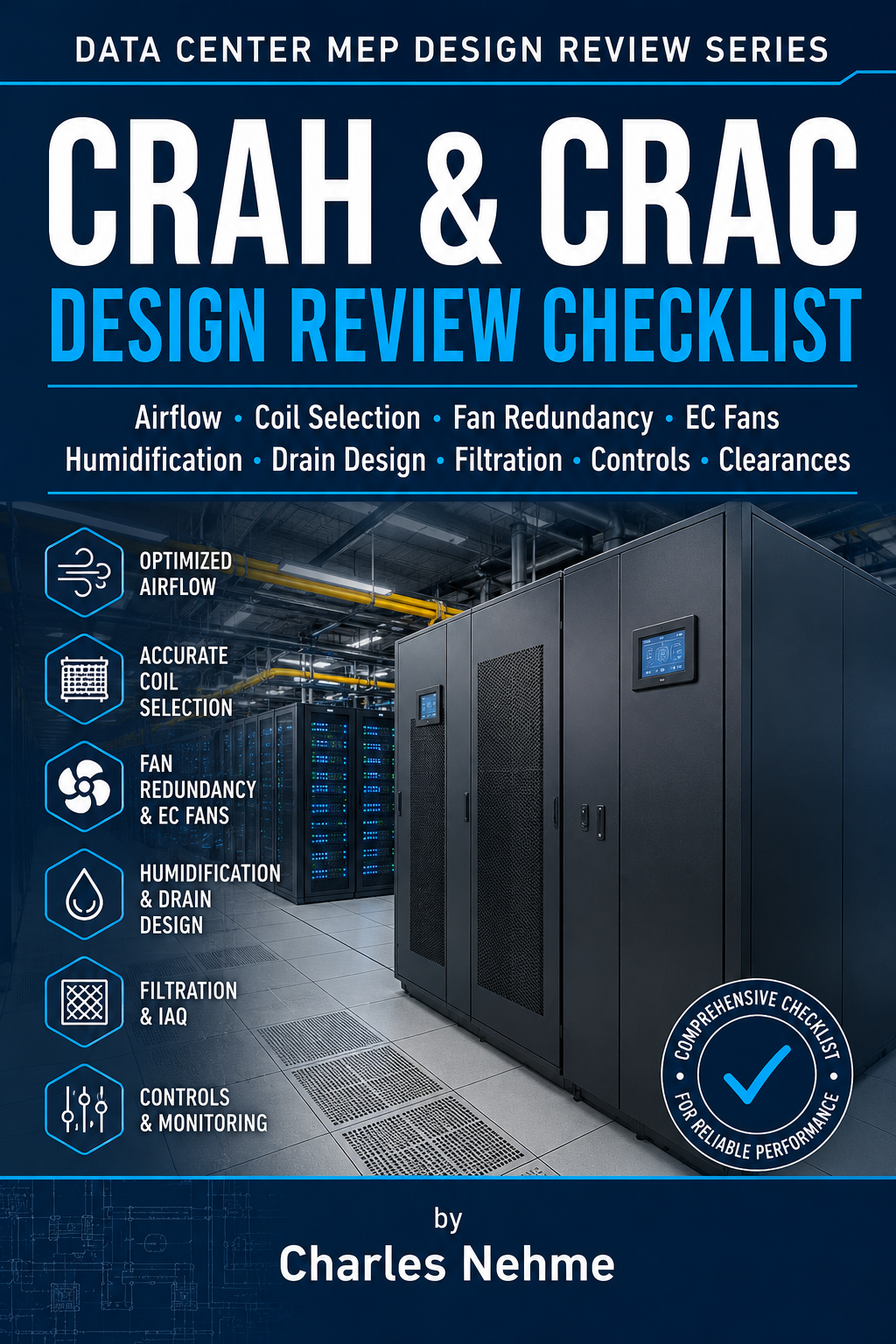
DATA CENTER MEP DESIGN REVIEW SERIES CRAH & CRAC DESIGN REVIEW CHECKLIST Airflow · Coil Selection · Fan Redundancy · EC Fans Humidification · Drain Design · Filtration · Controls · Clearances
Data Center CRAH & CRAC Design Review Checklist: A Practical Design and Commissioning Review Reference for MEP Engineers, Commissioning Agents, and Facility Operations Teams
Description:
Most CRAH and CRAC failures aren't equipment failures — they're review failures. A unit gets specified, submitted, and installed with the tonnage right and the details wrong: throw distance that never reaches the end of the row, a fan redundancy claim that doesn't survive a single-point-of-failure analysis, a humidification setpoint fighting itself across three units in the same room.
This checklist closes that gap.
Built for use at three points in a project — design review, factory/field acceptance, and operational readiness — it walks through the nine domains that determine whether a CRAH/CRAC deployment performs as designed or quietly underperforms for the next ten years:
✔ Airflow — containment strategy, plenum design, throw, and static pressure
✔ Coil selection — fouling factors, approach temperature, refrigerant circuits
✔ Fan redundancy — N+1 architecture and the failure modes each level protects against
✔ EC fans — efficiency curves, turndown, and fail-safe behavior
✔ Humidification — technology fit and the dual-setpoint conflict that wastes energy fleet-wide
✔ Drain design — pan slope, secondary containment, leak detection placement
✔ Filter arrangements — MERV selection and pressure-drop budgeting
✔ Controls — points lists, staging logic, sequence-of-operations review
✔ Maintenance clearances — IOM-specific access, NEC 110.26, rigging paths
Every chapter ends with a RAG-coded review table you can score in the field. Three appendices turn the book into a working toolset: a consolidated master checklist for printing and carrying into the room, an FMEA/RPN risk register scoring the ten highest-consequence failure modes, and a weighted scoring matrix for comparing competing vendor proposals on a like-for-like basis.
This is a review framework, not a substitute for manufacturer documentation — it's built to be used alongside the submittal, IOM manual, and startup report, not instead of them.
Who it's for: MEP design engineers running constructability and peer reviews, commissioning agents building Level 3–5 functional test scripts, facility managers evaluating an existing fleet, and consultants who need a common rubric for scoring vendor proposals.