
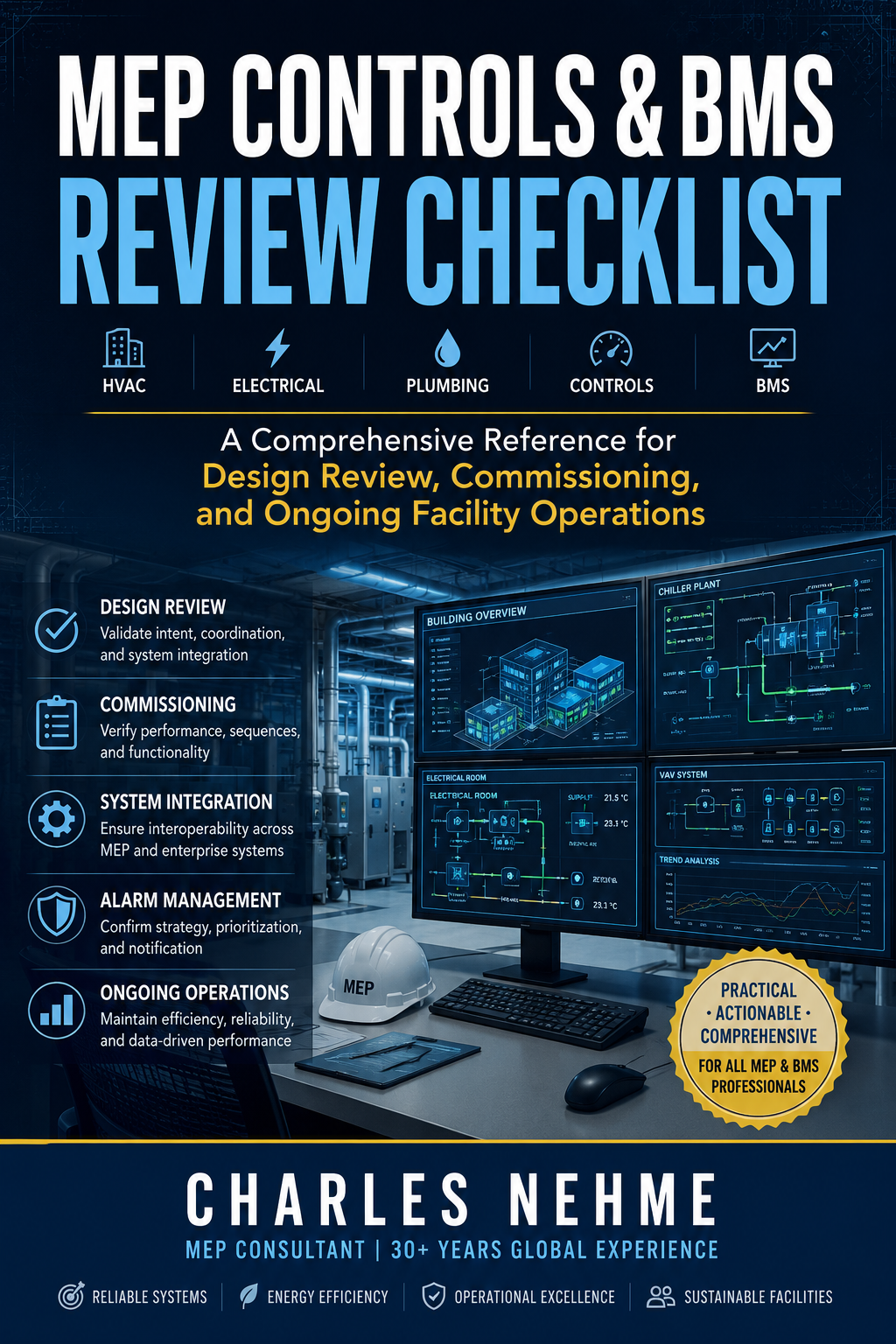
MEP Controls & BMS Review Checklist
Building Management Systems (BMS) and the MEP controls layer that they supervise sit at the intersection of every mechanical, electrical, and life-safety system in a facility. A control sequence that is technically correct on paper but poorly integrated, poorly commissioned, or poorly secured can quietly erode comfort, energy performance, equipment life, and — in critical facilities — uptime itself. This reference is organized as a working review tool rather than a textbook: each chapter pairs a short technical orientation with structured checklists that a reviewer can apply directly to drawings, points lists, sequences of operation, submittals, or an existing installation.
The checklists use a consistent Red / Amber / Green (RAG) scoring convention throughout. Green indicates the item fully meets the review criterion with no exceptions noted. Amber indicates a partial compliance, a documented workaround, or an item requiring follow-up before close-out. Red indicates non-compliance, a missing deliverable, or a condition that should block progression to the next project phase. RAG status is a communication tool, not a substitute for engineering judgment — reviewers should always record the specific basis for an Amber or Red rating in the Notes column.
Weighted scoring matrices are provided where a single pass/fail rating would obscure meaningful trade-offs — for example, when comparing BMS platforms or evaluating the overall maturity of a controls submittal. Failure Mode and Effects Analysis (FMEA) tables use the standard Severity × Occurrence × Detection formulation to produce a Risk Priority Number (RPN), letting reviewers triage mitigation effort where it matters most.
This book is a review and quality-assurance aid. It does not replace a licensed engineer's stamped design, the manufacturer's installation instructions, or the authority having jurisdiction's (AHJ) interpretation of applicable code. Numeric setpoints, thresholds, and cost figures shown in examples are illustrative starting points for calibration workshops, not universal defaults.
Charles Nehme Global MEP Consultant https://bit.ly/m/HVAC