
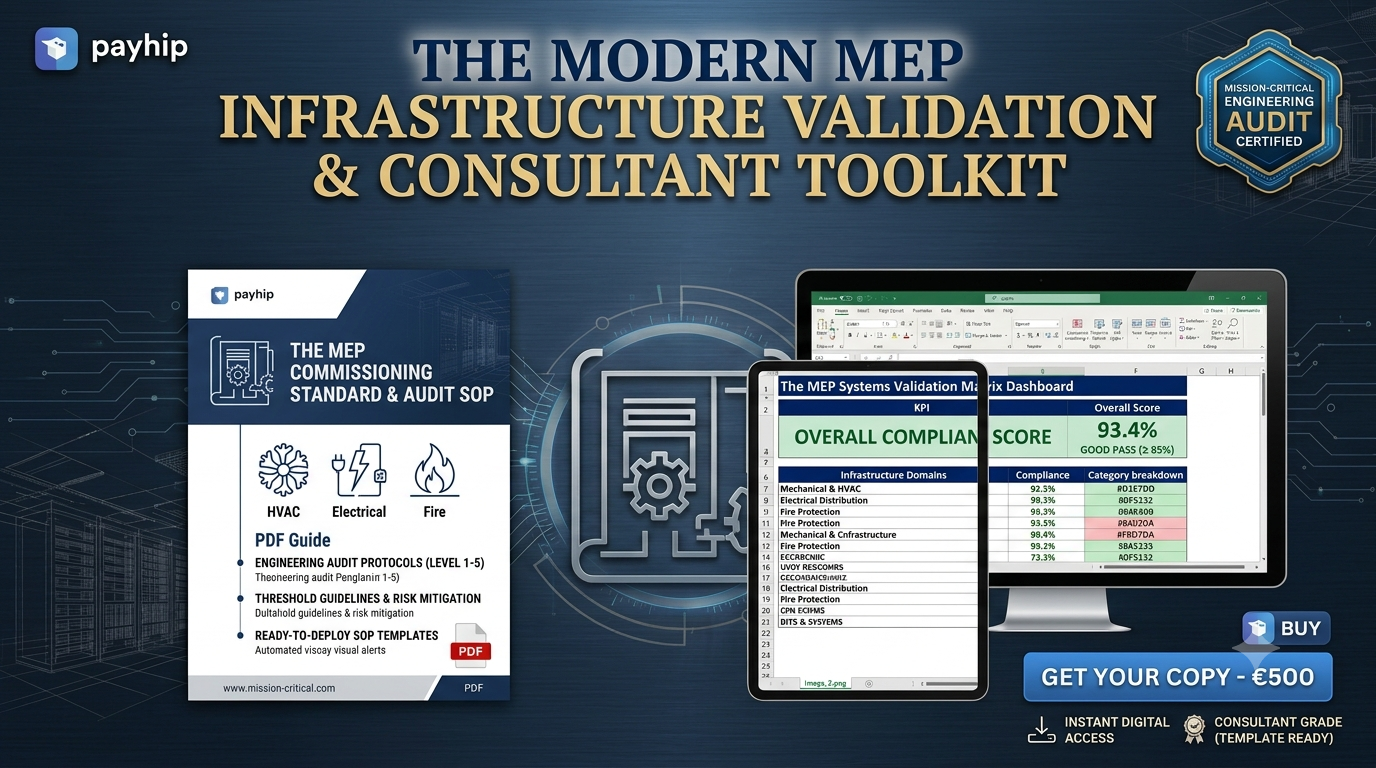
THE MEP PROJECT INFRASTRUCTURE VALIDATION & CONSULTANT TOOLKIT
THE MEP PROJECT INFRASTRUCTURE VALIDATION & CONSULTANT TOOLKIT
PREFACE & SYSTEM OPERATIONAL PROTOCOL
1. DOCUMENT PURPOSE & SCOPE
The MEP Construction Project Assessment Matrix is a specialized, dual-tab instrumentation framework engineered to evaluate physical installation quality, design engineering alignment, and system commissioning thresholds across critical built environments.
By standardizing a rigorous 100-point physical verification protocol, this toolkit enables independent Mechanical, Electrical, and Plumbing (MEP) consultants, general contractors, owners, and facilities directors to audit infrastructure with mathematical accuracy.
To ensure clean, presentation-ready formatting for executive review or physical printouts, this matrix purposefully omits long text explanations, condensing the workspace into an optimized, portrait-page footprint that maintains column stability regardless of assessment length.
2. CORE WORKSPACE ARCHITECTURE
The toolkit is structured as a unified, data-interlocked workbook consisting of two specialized tracking environments:
- Tab 1: Summary Dashboard (Executive Layer)
- An executive tracking interface that consolidates overall facility health indicators. It displays the cumulative points score, maximum possible evaluation limit, and an aggregate compliance percentage, backed by an isolated breakout table tracking the performance of each individual engineering discipline.
- Tab 2: Assessment Questionnaire (Engineering Layer)
- The deployment-ready audit engine containing 100 deep-dive technical validation criteria distributed across 8 fundamental physical disciplines:
- Mechanical & HVAC Systems (15 Items)
- Electrical Power Distribution (20 Items)
- Plumbing & Public Health (10 Items)
- Fire Protection Systems (10 Items)
- Building Management System / BMS (10 Items)
- ELV Networks & Security (10 Items)
- Structural & Civil MEP Support (10 Items)
- Testing, Commissioning & Operations (15 Items)
3. THE 1-TO-10 SCORING MECHANISM
Auditors evaluate each of the 100 items by entering an integer from 1 to 10 in the "Score Given" column based on physical asset inspection and documentation reviews:
- 9 to 10: Full Standard Compliance
- The system or element is entirely installed, structurally secured, and fully validated. All relevant Level 1 through Level 5 commissioning scripts are executed, as-built records are updated, and zero open punch-list items exist.
- 7 to 8: Substantial Compliance
- The equipment is physically sound, safe, and operational. Minor documentation delays or non-critical cosmetic corrections remain pending, but do not affect overall subsystem safety or uptime.
- 5 to 6: Partial Compliance / Marginal
- Capital machinery is present and active, but secondary safety loops or design redundancy goals show clear installation defects (e.g., cross-connected pathways or missing vibration isolators).
- 3 to 4: Non-Compliant / Poor
- Equipment is physically present on site but is completely non-operational, lacks mandated engineering tie-downs, or is missing structural site acceptance testing (SAT) validations.
- 1 to 2: Critical Defect / Absent
- The critical safety or engineering asset is completely missing from the build, introducing an immediate single-point-of-failure capable of halting facility operations.
4. COMPLIANCE THRESHOLDS & VISUAL ALERTS
In mission-critical and complex commercial developments, a construction assessment is only awarded an Acceptable Pass rating if it achieves a cumulative score of 85.0% or higher. Any score below this benchmark introduces unacceptable capital risk.
The toolkit features built-in Excel conditional formatting rules to instantly direct focus toward underperforming engineering domains:
These rules are globally hardcoded across the primary dashboard KPI card, the individual discipline breakout lines, and the overall summary totals to maximize visibility during stakeholder handovers.
For additional support for your Projects and excellent library of documentation , check out https://bit.ly/m/HVAC