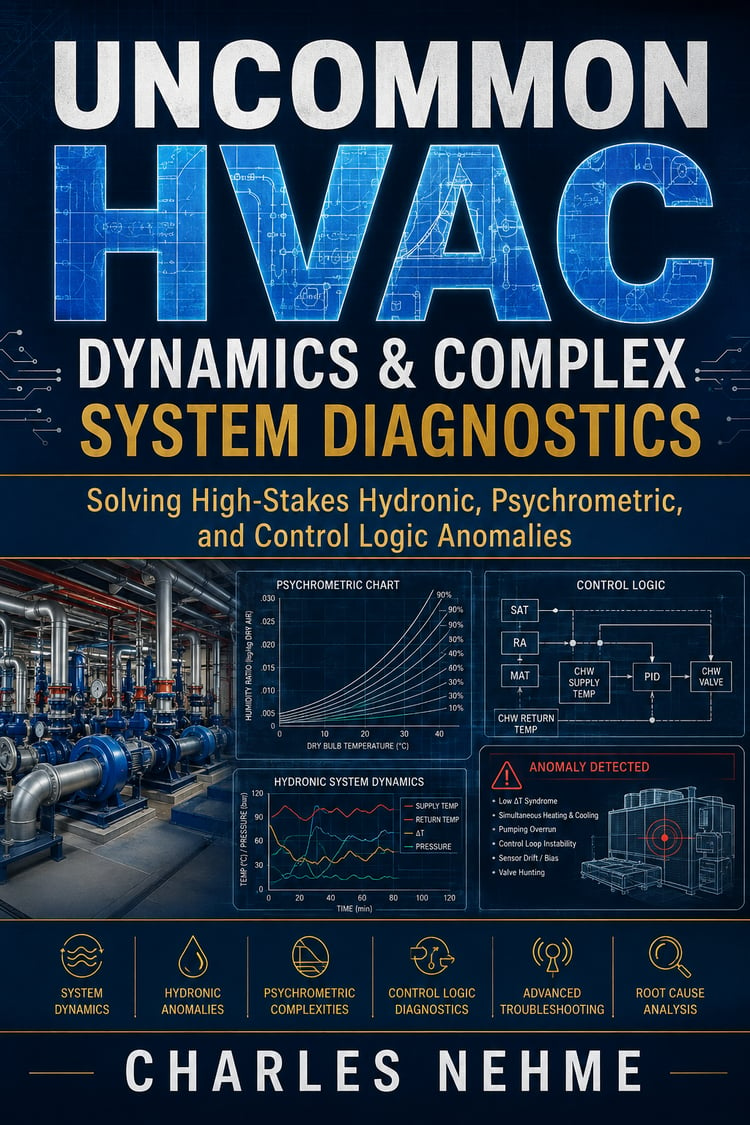

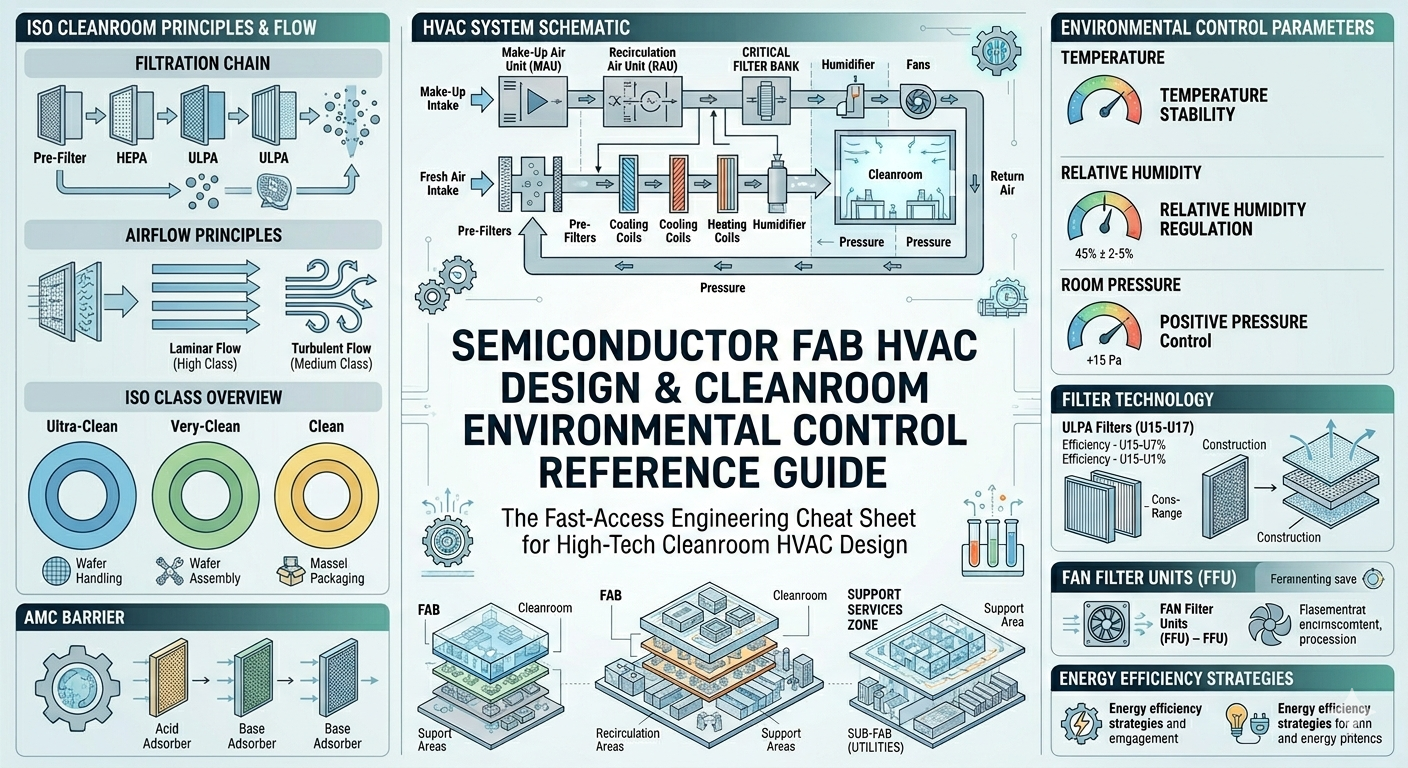
Semiconductor FAB HVAC Design & Cleanroom Environmental Control Reference Guide The Fast-Access Engineering Cheat Sheet for High-Tech Cleanroom HVAC Design
Semiconductor manufacturing represents one of the most demanding environmental control challenges in modern engineering. Unlike conventional HVAC applications, a semiconductor fabrication facility (FAB) is not designed merely for comfort—it is engineered as a precision-controlled production environment, where microscopic variations in temperature, airflow, pressure, and particulate contamination can directly influence product yield, process stability, and financial performance.
In these facilities, air is not simply conditioned; it is continuously engineered, filtered, balanced, and monitored to maintain an environment that can reach cleanliness levels down to ISO Class 1. Every zone within a FAB serves a distinct function, and each function imposes strict requirements on air change rates, pressure cascades, filtration efficiency, chemical safety, and vibration control. A deviation that would be negligible in a commercial building can be critical in a lithography bay or metrology room.
This reference guide has been developed as a practical engineering tool for HVAC designers, mechanical engineers, consultants, contractors, and facility operators involved in semiconductor and advanced cleanroom environments. It consolidates key environmental parameters into a structured format to support early-stage design decisions, system comparisons, and conceptual understanding of FAB zoning requirements.
Rather than replacing detailed design standards, OEM data, or project-specific specifications, this document is intended to provide a quick, high-value engineering overview of how environmental conditions typically align across semiconductor fabrication spaces. It bridges the gap between theoretical cleanroom classifications and real-world HVAC design implementation.
The parameters presented—covering air change rates, ISO classifications, pressure differentials, filtration strategies, airflow behavior, particle control levels, thermal stability, humidity control, exhaust systems, and contamination types—reflect industry-typical practices observed across advanced semiconductor manufacturing environments. These values should always be validated against specific tool requirements and project constraints.
Ultimately, the objective of this guide is to support faster, more informed engineering decisions in environments where precision is not optional, but essential. It is designed to serve as both a learning reference and a practical field companion for professionals engaged in the design, analysis, and operation of high-tech cleanroom HVAC systems.
Contact: cfnehme@gmail.com 1000 Related technical Books https://bit.ly/m/HVAC