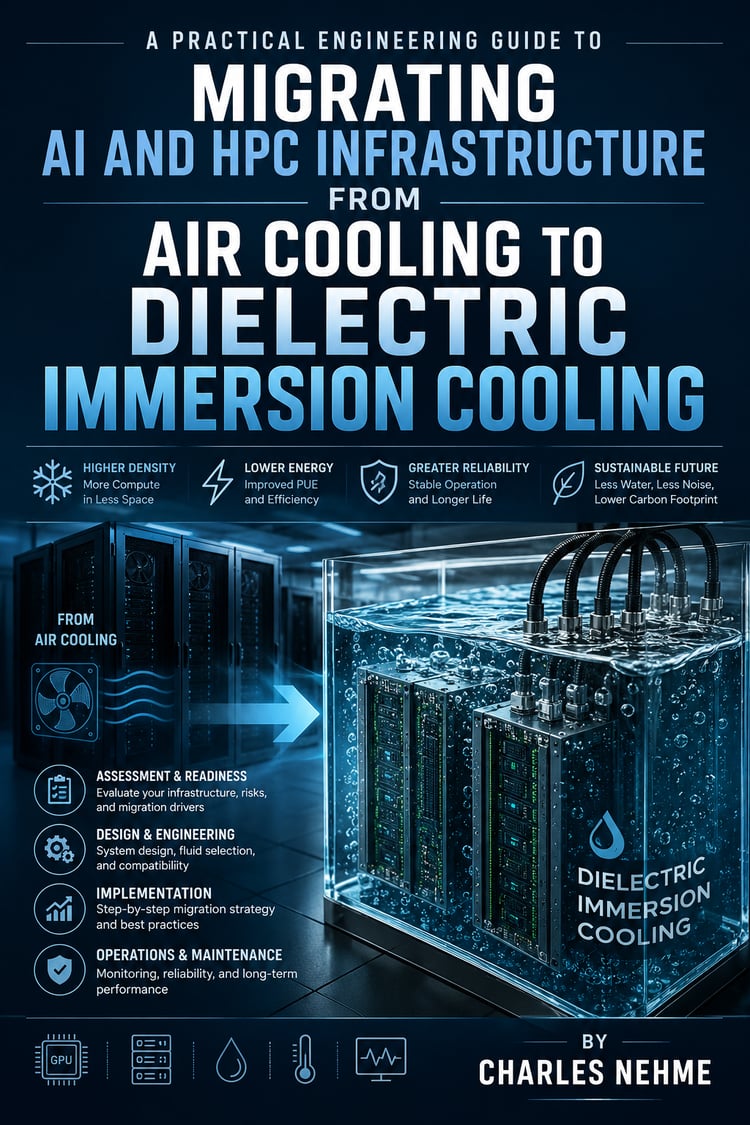

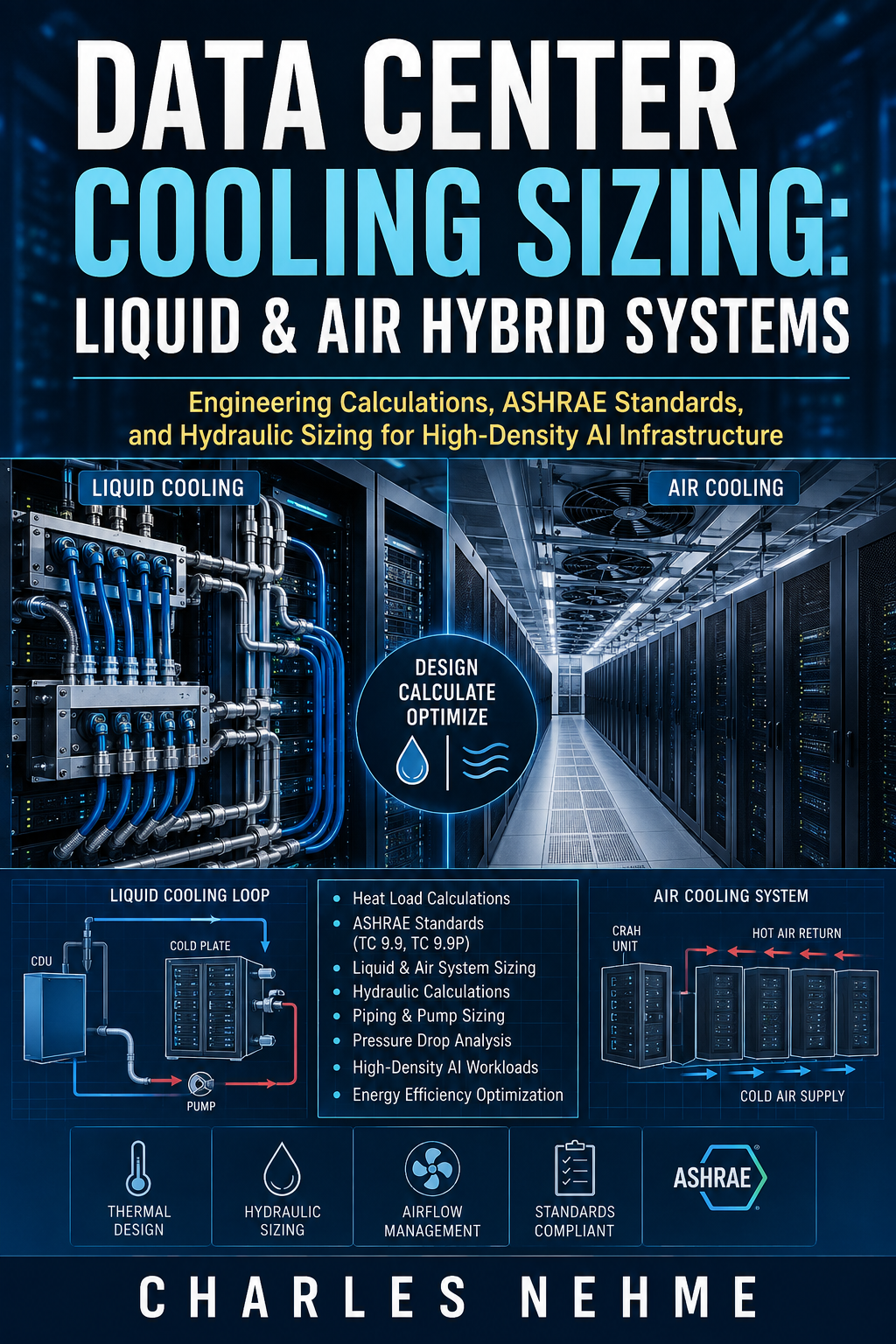
Data Center Cooling Sizing: Liquid & Air Hybrid Systems Engineering Calculations, ASHRAE Standards, and Hydraulic Sizing for High-Density AI Infrastructure
The rapid evolution of high-density computing—driven by artificial intelligence (AI), high-performance computing (HPC), and enterprise cloud workloads—has fundamentally altered the landscape of data center Mechanical, Electrical, and Plumbing (MEP) infrastructure. As rack power densities escalate beyond 50 kW to 100 kW+ per cabinet, traditional air-cooling methodologies reach their physical thermodynamic limits. The industry is witnessing an unprecedented shift toward hybrid thermal architectures: integrating Direct-to-Chip (DLC) liquid cooling, advanced fluid distribution loops, and dynamic white-space management.
This document and its accompanying analytical models were developed to address the pressing need for rigorous, standardized, and executable engineering frameworks in data center cooling design. Intended for senior MEP consultants, data center architects, commissioning managers, and facility operators, this material bridges the gap between theoretical thermal fluid mechanics and field-ready operational deployment.
Scope & Structure
The framework provided within this technical suite covers the core pillar calculations required to size, analyze, and optimize modern liquid-air hybrid infrastructure:
- Sensible Heat Load Allocation: Precision partitioning of IT power loads between direct liquid capture and residual room air dissipation.
- Secondary Fluid Loop Dynamics: Hydraulic sizing, mass flow rate determinations, and Coolant Distribution Unit (CDU) pump power calculations across diverse coolant media.
- Environmental Compliance: Automated verification against ASHRAE TC 9.9 thermal envelopes (Classes A1–A4) and Facility Water System (FWS) temperature thresholds.
- Hydraulic Velocity Sizing: Velocity-capped pipe and manifold sizing designed to mitigate erosion, corrosion, and pressure drop penalties.
- System Redundancy & Load Sharing: Dynamic N+1 and 2N failover modeling for CDUs and Computer Room Air Handlers (CRAHs) under steady-state and fault conditions.
Methodology & Standards
All algorithms, fluid property matrices, and sizing heuristics embedded in these tools strictly adhere to current global data center engineering standards, including:
- ASHRAE TC 9.9: Thermal Guidelines for Data Processing Environments
- Uptime Institute Tier Standard: Topology & Operational Sustainability
- EN 50600 / ISO 50001: Information Technology Facilities and Energy Management Systems
By providing transparent, open formulas and adaptable Python/Excel logic, this suite empowers engineering teams to rapidly evaluate trade-offs in Partial Power Usage Effectiveness (pPUE), fluid selection, and spatial clearance without relying on opaque "black-box" proprietary software.
Charles Nehme
MEP & HVAC Global Consultant https://bit.ly/m/HVAC