
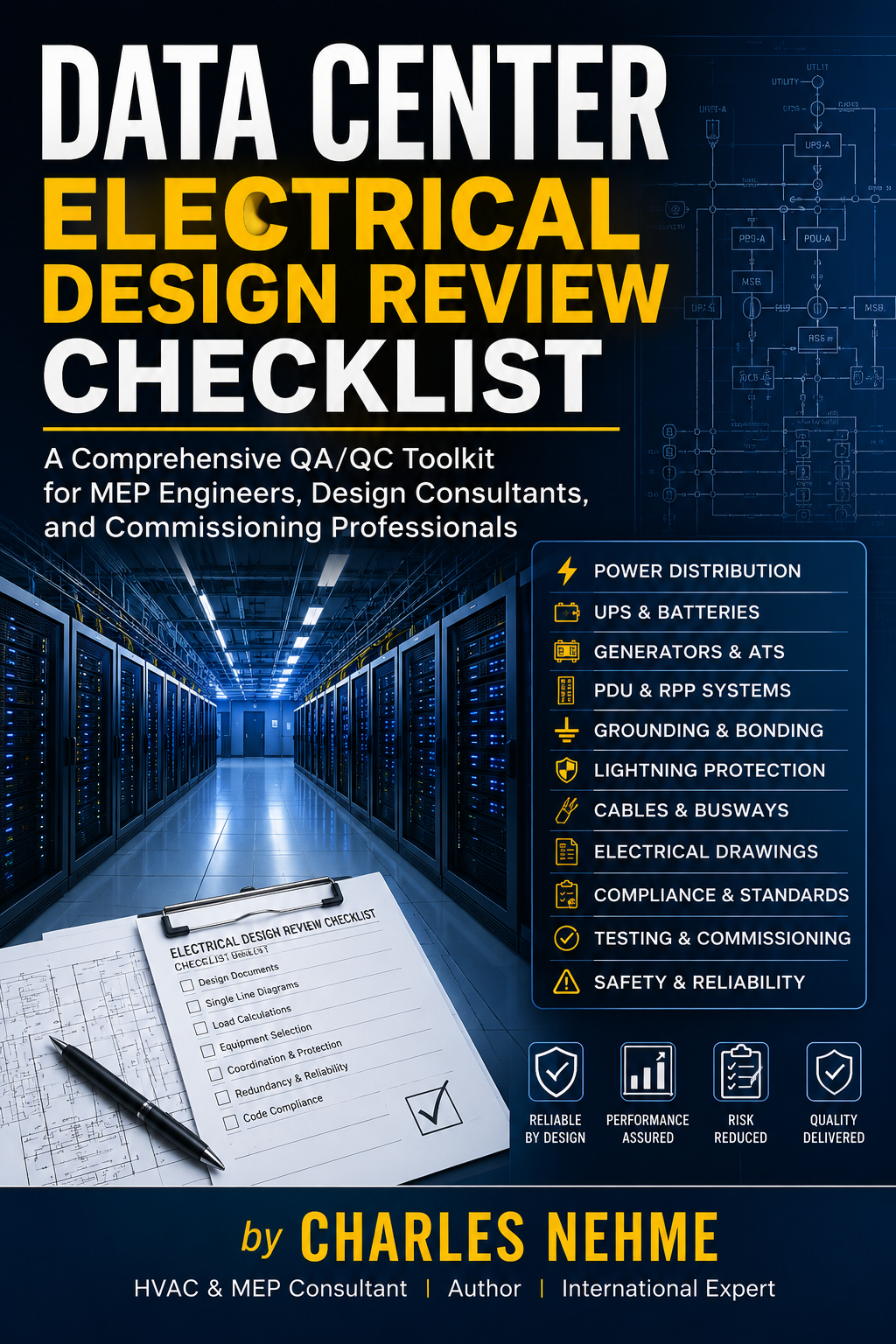
DATA CENTER ELECTRICAL DESIGN REVIEW CHECKLIST A Comprehensive QA/QC Toolkit for MEP Engineers, Design Consultants, and Commissioning Professionals
Data center electrical infrastructure has grown more complex and more consequential with every design cycle. Rising rack densities, AI/HPC compute loads, tightening utility interconnection queues, and owner demands for Tier III and Tier IV concurrent maintainability have pushed electrical design review from a late-stage formality into a continuous, document-driven discipline that spans schematic design through commissioning.
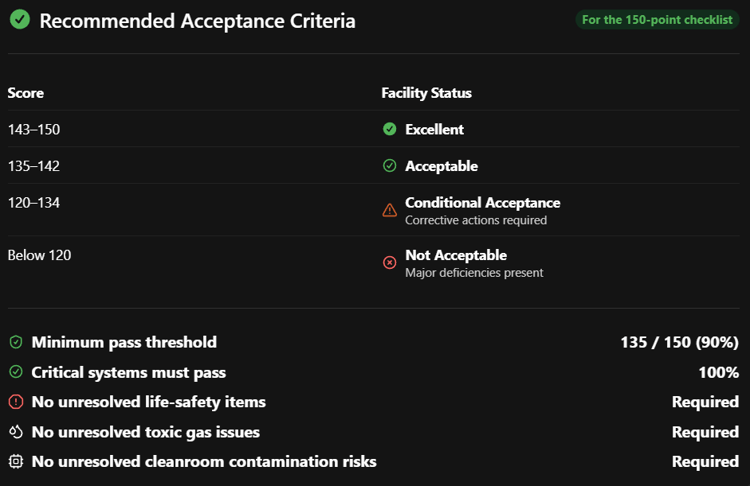
This book distills that discipline into a single, structured reference. Each chapter isolates one electrical system — utility service, standby generation, UPS, distribution, grounding, protection, life safety interfaces, and monitoring — and walks the reviewer through the specific items that must be verified before a design package can be released for construction. Every checklist item is cross-referenced to the governing code or standard, and every chapter closes with a RAG-coded (Red/Amber/Green) status framework so that review findings can be tracked, escalated, and closed out consistently across a project team.
Beyond the checklists, this book provides the analytical tools that separate a compliance review from a true reliability review: a Failure Modes and Effects Analysis (FMEA) framework calibrated to electrical infrastructure, a lifecycle cost (LCC/NPV) comparison structure for capital equipment decisions, and a weighted scoring matrix for topology and vendor selection. These tools are intended to be adapted directly into project-specific review packages.
This book is written for design engineers, MEP consultants, owner's engineers, commissioning agents, and facility managers involved in the design review, peer review, or independent third-party review of data center electrical systems, from single-tenant edge facilities through hyperscale campuses.
Charles Nehme, Global Consultant plus books publisher https://bit.ly/m/HVAC
Note: This book is a design-review aid, not a substitute for a licensed Professional Engineer's stamped design or for the Authority Having Jurisdiction's (AHJ) code interpretation. Always confirm the applicable edition of referenced codes for your jurisdiction and project date.